

Every February, the NFL Combine dominates sports headlines as scouts, coaches, and analysts break down test results like they’re predicting the future. But what do those numbers really mean? Why does a quarterback’s 40-yard dash time matter less than a cornerback’s vertical jump? What can a 3-cone drill time tell you about a player’s ceiling? Understanding NFL combine tests gives you insight into how scouts evaluate talent, what makes a prospect valuable, and why some athletes test great but don’t translate to the field. Whether you’re a coach, athlete, parent, or serious football fan, this breakdown of NFL combine metrics will help you decode the data and understand what scouts are actually looking for.
What Is the NFL Combine?
The NFL Combine is an annual scouting event held in Indianapolis where roughly 300 college football prospects are evaluated by all 32 NFL teams. It’s been running since 1982 and has become the gold standard for athlete evaluation across all levels of football. The Combine standardizes testing (same drills, same equipment, same conditions) so scouts can compare athletes objectively.
For NFL teams, the Combine is one of the final pieces of the puzzle before the draft. Teams have game film, all the tape, medical records, and interviews. But the Combine provides real-time, side-by-side evaluation of pure athleticism. A player might look great on tape, but how fast are they really? How explosive? How do they move in space compared to their peers? The Combine answers those questions with objective data.
It’s important to note: Combine performance doesn’t guarantee NFL success, and it doesn’t predict everything. Some Hall of Famers didn’t test particularly well. But for scouts trying to project a college player’s ability to transition to the NFL level—where everyone is bigger, faster, and more skilled—the Combine data is invaluable.
The 40-Yard Dash: Speed, Explosion, and What Scouts See
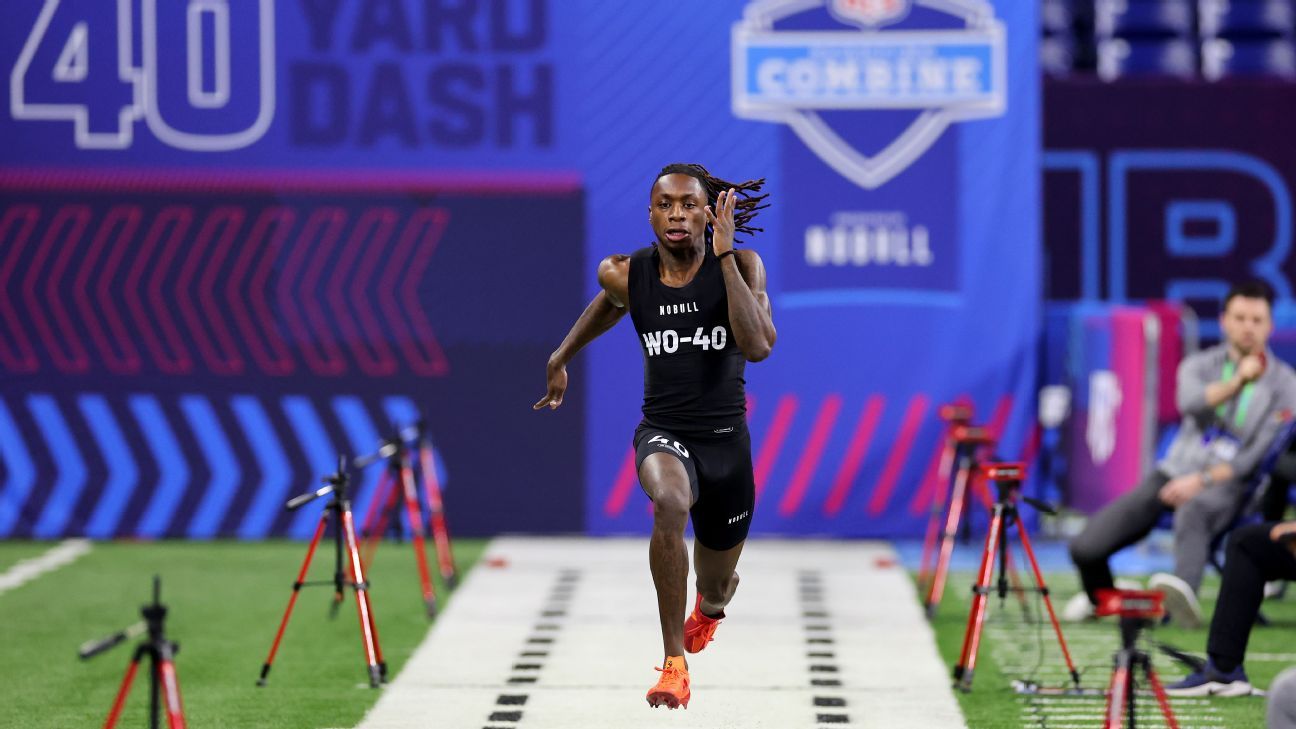
The 40-yard dash is the most famous combine drill. It’s straightforward: athletes line up in a three-point stance at a starting line, explode forward on command, and run 40 yards as fast as possible. Two electronic sensors record the time to the hundredth of a second. Most prospects run twice, and the better time counts.
What the 40 Actually Measures
The 40-yard dash primarily measures straight-line speed and explosiveness off the line. Scouts break it into phases: the first 10 yards (acceleration and get-off), the middle 20 yards (maximum velocity), and the final 10 yards (sustained speed). Different positions value different phases. A cornerback needs that explosive first step. A receiver needs to maintain velocity. A tackle needs enough speed to cover ground while moving laterally.
Position-Specific Standards
What’s considered “good” varies by position. A defensive end running 4.75 seconds is elite. A cornerback at 4.75 is slow. Here’s why: cornerbacks are expected to run faster because coverage requires pure speed. Defensive ends need size and power more than blazing speed. Quarterbacks rarely even run the 40 anymore because it doesn’t correlate to on-field success. Teams care more about arm strength and accuracy.
The Nuance Scouts Look For
Raw time is just part of the story. Scouts watch slow-motion video of each 40-yard dash. How is the athlete leaving the line? Are they smooth and fluid or stiff? Do they maintain their acceleration through 20 yards or do they fade? A player who runs 4.65 with a clean, powerful stride might be more valuable than someone who runs 4.60 but looks uncomfortable in their body.
Bench Press: Strength, Reps, and What 225 lbs Tells Scouts
The bench press at the NFL Combine involves lifting 225 pounds as many times as possible. Each completed rep is counted. Most players do somewhere between 10 and 40 reps depending on position and strength profile.
What It Measures
The 225-lb bench press measures muscular endurance and upper-body functional strength. In football, you’re not trying to bench-press once for maximum weight—you’re applying force repeatedly: shedding blockers, fighting off receivers, driving through defenders. The bench press reps simulate that endurance-based strength application. A linebacker who does 32 bench press reps is showing he has the upper-body staying power to survive 75 plays on a Sunday.
Position Relevance
Defensive linemen and linebackers typically put up the highest rep numbers (30+) because these positions are strength-dependent. Offensive linemen also bench heavy. Skill position players (receivers, defensive backs, running backs) might only do 15–20 reps because their athleticism profile relies less on raw pressing power. Quarterbacks barely bench press at all in the combine.
Why 225 lbs?
The NFL chose 225 pounds because it’s heavy enough to be meaningful but light enough that even lighter athletes can complete reps. It’s been standardized since the Combine started, so comparing this year’s prospects to Hall of Famers is possible. The test isn’t about being the strongest; it’s about relative strength and endurance at a standard weight.
What Falls Between the Cracks
The bench press doesn’t measure lower-body strength (that’s implied by other drills), and it doesn’t measure how strong you are in game situations—moving laterally, striking from awkward angles, fighting drive-through contact. It’s one data point. Elite defenders have done fine with moderate bench press numbers. It matters, but it’s not determinative.
Vertical Jump and Broad Jump: Measuring Lower-Body Power
Vertical Jump Explained
Athletes stand facing a wall or vertical jump apparatus with arms at rest. They jump as high as possible, and the difference between their standing reach and peak jump height is recorded. Most prospects also perform an approach vertical (one or two steps before the jump) to measure how well they generate power with momentum. The vertical jump isolates lower-body explosion and hip extension.
Why It Matters for Every Position
Pass-catchers need vertical jump to box out defenders and climb the ladder. Safeties need it to range over the top. Defensive backs need it to break up passes. Even offensive linemen benefit from vertical explosiveness—it correlates with the ability to get off the ball quickly. It’s a universal measure of lower-body power in a way that 40-yard times aren’t.
Broad Jump: The Underrated Gem
From a standstill, athletes jump horizontally for maximum distance. Broad jump correlates extremely well with on-field performance because it combines power, balance, and hip explosion in one movement. A prospect who broad jumps 10+ feet is demonstrating elite lower-body athleticism. Scouts often trust the broad jump more than the vertical because it’s harder to game or have a bad day on.
Standstill vs. Approach Metrics
Standstill jumps (vertical and broad from a stationary position) measure raw power. Approach jumps measure how well athletes use momentum. Football is dynamic—you’re rarely standing still. Scouts compare both. If an athlete broad jumps 9’8″ standing but only 10’2″ with an approach, that tells scouts their power isn’t translating well to dynamic movement.
3-Cone Drill and 20-Yard Shuttle: Agility Under a Microscope
The 3-Cone Drill (L-Drill) Setup
Three cones are set up in an L-shape: one at the start line, one 5 yards away, and one 5 yards to the side of that cone. Athletes sprint 5 yards to the first cone, plant and sprint back to the start, then sprint 5 yards in the opposite direction before going around the third cone in a figure-eight pattern. Total distance is about 40 yards, but the drill is really about direction change, foot speed, and body control.
What 3-Cone Tells Scouts
The 3-cone drill measures lateral quickness, deceleration ability, and transition speed. Cornerbacks and receivers need to plant and change direction instantly. Linebackers need to flow laterally then scrape downhill. Defensive backs typically run the 3-cone in 6.5–7.0 seconds. Linebackers in 6.8–7.2. Any time under 7.0 is elite regardless of position. Times over 7.3 raise red flags—you’re not sharp laterally.
The 20-Yard Shuttle Breakdown
Athletes stand at the start, sprint 5 yards to one side, plant, sprint 10 yards across to the opposite side, plant, and sprint 5 yards back to the start. It’s a smaller, more reactive version of the 3-cone. The shuttle measures the ability to stop, start, and redirect—core movement skills in football.
Reading the Agility Numbers
Good shuttle times are around 4.1–4.3 seconds for fast athletes. Anything under 4.0 is exceptional. The 3-cone should be roughly 1.5–1.7 times the shuttle time. If an athlete crushes the shuttle (4.0 flat) but struggles on the 3-cone (7.2), it suggests they can start and stop fine but lack multi-directional agility. That’s valuable information for scouts predicting game performance.
Position-Specific Drills: How Each Group Is Evaluated
While the core drills apply to everyone, scouts add position-specific evaluations:
Receiver and Defensive Back Route-Running Trees
Receivers run precise route trees—slants, posts, digs, corners—and scouts watch release quickness, foot precision, and ability to change direction smoothly. For defensive backs, it’s mirroring footwork and transition speed. These aren’t timed like the 40-yard dash, but they’re filmed and graded extensively by position coaches.

Quarterback Pro-Day Mechanics
Most quarterbacks don’t attend the full Combine. Instead, they work out at their college’s pro day where they throw to receivers, do footwork drills, and show arm strength from various arm angles and platforms. Scouts measure release time, ball placement, and consistency. Raw arm strength is important, but placement and mechanics matter more.
Offensive and Defensive Line Drills
Linemen do lateral shuffle drills, get-off explosiveness tests, and sometimes pad-level assessments to see how low they play. They might move weighted sleds or do acceleration-focused sprints to show drive-off capability. The bench press reps matter more for linemen than most other positions.
Linebacker and Safety Movement Patterns
These positions might run scrape drills (moving laterally then downhill), zone coverage movements, or pass-rush step-overs to assess their ability to transition between coverage and run defense. Film is reviewed constantly for these positions because the movement patterns on film matter as much as Combine numbers.
How Youth Programs Can Run Their Own Combine Testing
You don’t need the NFL infrastructure to run professional-grade athlete evaluation. Many successful youth and high school programs implement combine-style testing:
Standardize Your Drills
- Choose 5-7 core drills: 40-yard dash, vertical jump, broad jump, shuttle run, 3-cone (or agility course), bench press (age-scaled), and one position-specific drill.
- Use the same setup, spacing, and conditions each testing session so data is comparable across time.
- Time everything with consistent equipment—hand timing introduces human error, so invest in a radar gun or electronic timing system if possible.
Create a Testing Schedule
Run combines at the start of season (baseline), mid-season (progress check), and end-of-season (final measurement). Athletes see their improvement, which is motivating. You identify which players made the biggest gains and can track the effectiveness of your training program.
Leverage Video and Feedback
Record every rep. Slow-motion video shows mechanics, first-step quality, and movement fluidity that raw times don’t capture. Share video feedback with athletes—they want to know how they performed and where they can improve. This turns testing into a development tool, not just an evaluation.
Combine Testing with Game Film
Compare combine numbers to game performance. Which drills correlate most with game success at your program? Maybe your best corner didn’t jump the highest, but had the fastest shuttle. That’s data. Use it to refine your evaluation and focus your player development.
Run Professional-Grade Combine Testing for Your Program
Bring a combine-style evaluation to your youth or high school team. TeamGenius makes standardized athlete testing simple—from setup through video analysis, digital scorecards, and progress tracking. Evaluate like the pros.
Interested in running your own combine? Learn more at TeamGenius!
Frequently Asked Questions
Core drills include the 40-yard dash, vertical jump, broad jump, bench press (225 lbs), 3-cone drill, 20-yard shuttle, and position-specific workouts (routes, throws, etc.). Teams also conduct interviews, medical exams, and review game film extensively.
It depends on position. Cornerbacks under 4.70, safeties under 4.65, and receivers under 4.75 are considered elite. Defensive ends under 4.80 and linebacker under 4.85 are solid. Offensive linemen rarely break 5.0. Context matters—a 4.65 time on a tall receiver is more valuable than the same time on a shorter one.
Defensive linemen and linebackers typically do 30–40+ reps. Offensive linemen do 25–35 reps. Skill position players do 15–25 reps. Some athletes exceed 40 reps; it’s not uncommon. The recorded reps must meet NFL standards (full range of motion, flat feet on bench, controlled descent).
Absolutely. Scale weights and distances to your athletes’ age and development level, use consistent drills, time everything accurately, and build video analysis into your process. Youth combines give athletes valuable feedback, help coaches identify position fits, and create objective comparison data across your roster.
Leave a Reply